
Summary: Personalized brain games for seniors can help support cognitive function and create meaningful moments, even as memory challenges progress. This blog highlights engaging programs, life enrichment activities, and events that may help slow decline while strengthening emotional connections with loved ones.
- Use familiar-face matching games to spark recognition and reinforce memory pathways
- Create personalized trivia based on life events to encourage reminiscence and confidence
- Start with simple, meaningful puzzles (like family photos) and increase difficulty gradually
- Incorporate word games to support language skills and communication
- Explore gentle video games as a fun, research-backed way to boost memory and engagement
To watch a loved one face cognitive decline can be awful, with the inevitable question of what you can possibly do to help. Thankfully, there are numerous considerations you can take beyond the day-to-day love and support you offer.
While there is no cure for dementia or Alzheimer’s disease, research suggests even just a bit of brain training each day can potentially help slow cognitive decline. And making the games for both positive cognition and an individual’s firsthand experiences can make the exercise potentially fun and engaging.
Here, we have put together a few ideas of the best brain games for seniors to consider trying with your loved one. Each offers a fun, simple, and meaningful way of spending time with your loved one while you help them keep their dementia at bay.
A Matching Game of Familiar Faces
In our childhoods, we’ve likely all played a preschooler’s matching game, in which a dozen or so cards are laid face down and then flipped in pairs to try and find a match. This is helpful for a growing brain. But for a cognitively impaired brain, it can be a means to help support brain function and help strengthen short-term memory connections.
But what if we told you the matching game could do double duty beyond sheer fun? Rather than featuring barnyard animals or colorful shapes, consider employing a deck of personalized match cards featuring the faces of your loved one’s family.
As they play and flip the cards, they can be met with pairs of smiling faces they may recall. While it may be too much for your loved one to remember each of the people they are seeing, consider asking if they recognize anyone in the deck as they flip. You may be surprised at the result.
Topically Relevant Trivia Questions
While a game of Trivial Pursuit may be out for your loved one, simplifying and personalizing a game of trivia may be a fun way of helping to boost their confidence and enjoy a little reminiscence while they’re at it.
Consider tailoring trivia questions to a pivotal period in their personal history. Or to notable moments in our country’s history from when they were young. You can even personalize the trivia game and try to inject some local and familial questions into the deck as well.
The goal of these brain games for seniors might not be to get every question right, but to see what memories answering unlocks. And if you help to trigger even just a single lucid memory in your loved one, well, we would consider that a win!
Simple Puzzles
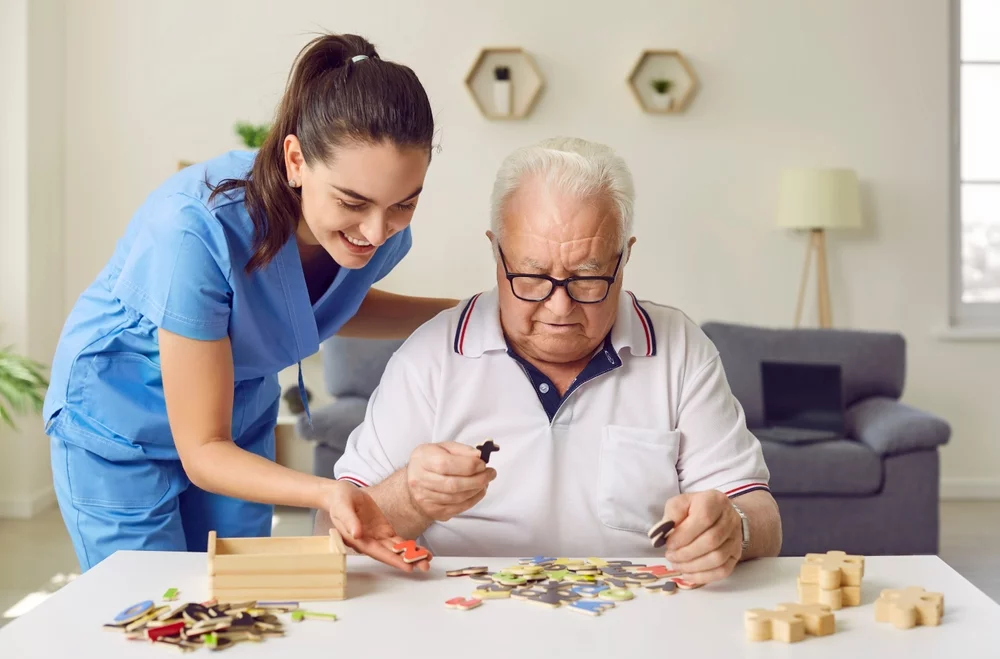
While that 1000-piece, all clear puzzle may be asking too much of your loved one, a simpler puzzle is certainly within reason. Consider starting simply, with a small puzzle featuring distinct and easily manipulated pieces and then scaling up the difficulty slowly and mindfully from there.
To help further personalize the experience, consider having a custom puzzle made featuring a family photo, a picture of their childhood home, or another image of personal importance. As each piece is laid, your loved one will connect not just with the fun but with the image they are assembling as well.
A Litany of Word Games
Imagery isn’t the only thing to help support cognitive function in older adults, though! Word-related brain games for seniors, such as simplified crossword puzzles, word searches, and jumbles, can help maintain their mastery of language and communication.
Consider creating your own simplified and personalized version of these games. Layer in potentially familiar names, places, and objects from your loved one’s personal history. You never know what might spark a moment of clarity in your loved one.
Simple Video Games
Video games have long been celebrated for their increasingly complex experiences. But did you know beyond sheer entertainment value, they may help or can offer benefits?
Research has shown video games can help age-related cognitive decline. Research suggests video games may support memory and cognitive function in older adults. And while not all modern games might be appropriate, one of the greatest benefits of the medium is there are so many games to choose from.
Consider engaging puzzle games (such as Unpacking or Tetris), simple and relatively gentle 3D experiences (such as Super Mario, Animal Crossing, or A Short Hike), or even gentle narrative games (such as What Remains of Edith Finch or Botany Manor). Any of these, along with countless others available on modern consoles, computers, and smartphones can help serve your loved one as engaging, low-complexity, and fun brain exercise games for seniors.
Memory Care for Your Loved One
If your loved one continues to face dementia and could use a more supportive residential environment, consider Summerfield Memory Care of Encinitas.
Our memory care community gets round-the-clock support from our friendly staff to ensure each moment is safe and supported. With brain-friendly nutrition options, and game-style enrichment programs, including immersive brain exercise games for seniors, baked into the schedule, your loved one will find fun and comfort as we work together to help support cognitive function or help maintain cognitive abilities.